

Our Common Individuality
If we can’t see our common individuality, we tend to lose both our commonality and our individuality.

There is an idea from the Bible that humanity was created in God’s image. It’s a pretty good idea, as far as human flourishing goes. The idea is a pillar of Western Civilization. The idea is we are inherently valuable because of our humanity.
Unfortunately, the idea seems to dissipate as we get past our Dunbar limits. Robin Dunbar discovered that at a given time you can only hold around 120-170 people in your mind as friends. He defines that as people you are willing to stop and talk to if you saw them in public. Once you get past that limit, you’re dealing with strangers. It’s not hard and fast, but don’t get caught on that. Read his books.
When we expand from home to town, city to county, state to nation, we tend to shift from the personal to the institutional. From ‘Joe is honest and good with cars,’ to ‘The Ford dealership is nearby.’
The individual relationships that make up the fabric of a family, or a local community are no longer efficient enough to effectively operate our societies. (Important to consider towards what end is society aimed? That is Moloch’s purview, perhaps.) The nuclear family is becoming further atomized, our consumption further stylized, all for the GDP.
The overwhelming sense that I get is that unity is impossible. Unity at any level is a miracle. Perhaps it only ever occurs when incentives align.
Individuals
Division is ancient in humanity. Cain dividing Abel from himself.
The strange truth is the impossibility of this division. In a way it worked, Cain was no longer confronted with his brother’s superiority. And yet, Abel was what Cain wanted to be. Cain divided his ideal from himself, but he was still left with his judge.
Cain and Abel were both images of God. The rivalry came from their relationship with God. Abel was smiled upon, and Cain was frowned upon.
Now Abel kept flocks, and Cain worked the soil. In the course of time Cain brought some of the fruits of the soil as an offering to the Lord. And Abel also brought an offering—fat portions from some of the firstborn of his flock. The Lord looked with favor on Abel and his offering, but on Cain and his offering he did not look with favor.
Genesis 4:2-5 NIV
Abel was different from Cain, and that difference was untenable for Cain. God’s rejection of Cain’s sacrifice was taken to be a rejection of Cain, and with this theology Cain auto-deified and rejected Abel.
The term individual means not-divisible. Perhaps I’ve been reading too much philosophy but what is not divisible? Under which conditions? If you could divide a person, what would that mean? Soul and body, mind and body, parts of body from rest of body? An individual is the smallest possible unit of something. Life?
I’d like to work with the ancient conception written in Genesis, upon which much of Western Civilization was constructed: An individual is the smallest possible representation of the cosmic order; more precisely the cosmic Orderer.
Cain brought some of the fruits, and Abel brought fat portions from the firstborn.
So, what you prioritize, what you worship, shapes your perception of the world.
Perception is deeply important. You adapt and fit and reshape yourself through your perception. If you perceive a predator, you may drop your belongings and begin to focus on your ability to move quickly through space, or if you perceive a difficult problem, you may remove distractions and attempt to think deeply about it, or an obstacle between you and something you want, and you may crouch to get under it, or climb to get over it. In each case you are adapting your self to the perceptions.
The divine, that thing at the top of your value hierarchy, is that which most fundamentally shapes you.
“What comes into our minds when we think about God is the most important thing about us.”
A. W. Tozer, Knowledge of the Holy
So an individual is the smallest possible unit of the image of God in the world. But what that individual sees God to be has the biggest possible impact on his presence in the world.
Communal Structures
Is there a way in which individuals can participate in the divine spirit of God that allows for the incorporation of all our uniqueness into some form of unity?
The Mandelbrot Set may be a useful analogy. It was discovered by Benoit Mandelbrot who knew how to discover something like this because he was in charge of mapping coastlines. While working at IBM he typed up a recursive formula which when reiterated infinitely (or something like that) discovered this beautiful structure in numbers.
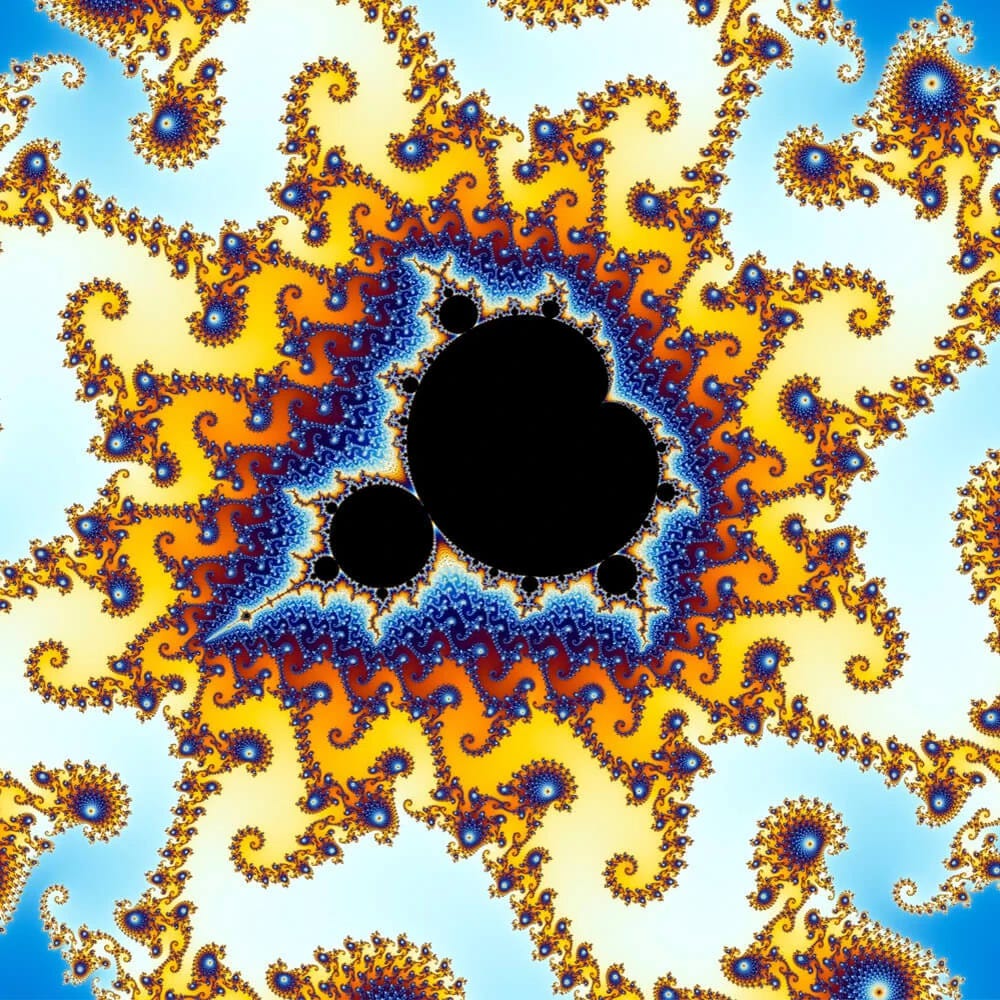
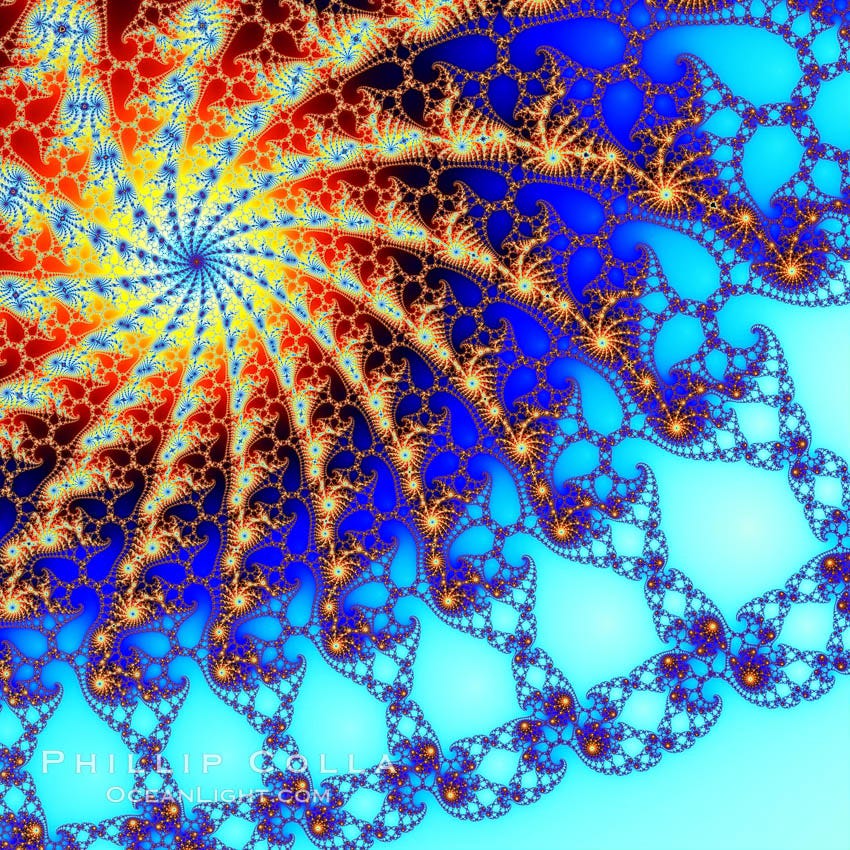
The overall pattern is represented again and again, but without exact replication. It is not a fractal like a square divided into four squares, or a line into two equal segments. It’s rougher than that. It is repetitive, but not identically. There are seahorses and elephant valleys, and buds, and mini-brots. There is variety throughout the complex, incomprehensible structure.
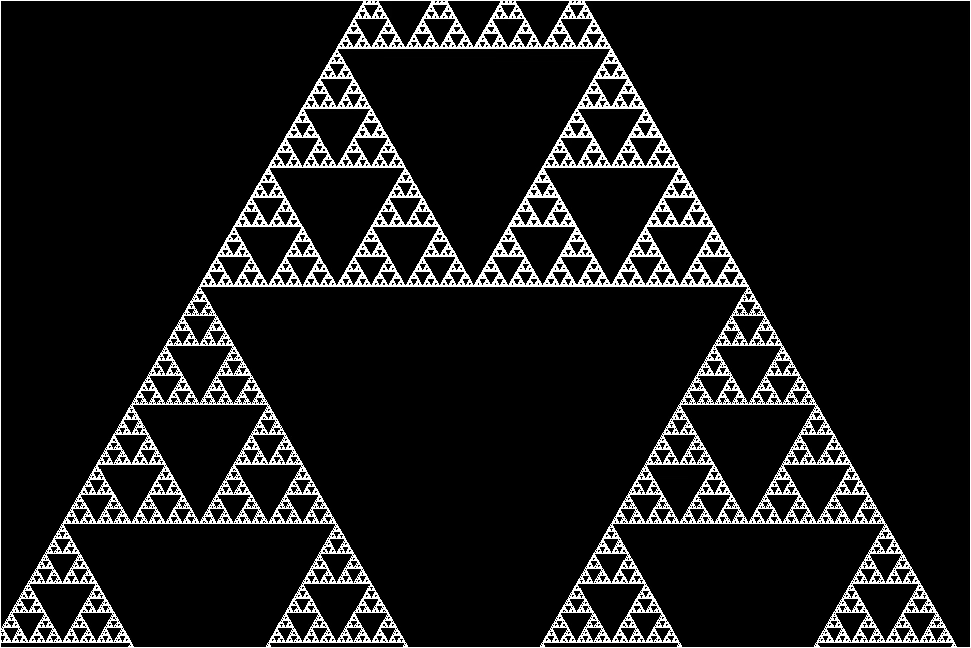
People have also tried to create fractals, or shapes that can be divided into complex and precisely self-similar shapes. The Sierpinski triangle being such a structure.
Two Ends and Two Means
The Sierpinski Triangle is created by taking an initial triangle and recursively removing the central triangle formed by connecting the midpoints of its sides (see the upside down black triangles above).
The shape at the pinnacle of the hierarchy is reiterated everywhere, even in the negative. It is a beautiful fractal, albeit in a very Harkonnen way.
Many institutions operate on the same principle: they are made of self-similar shapes. The demands of similarity dictate conformity from the component parts of a structure like this.
Sierpinski Structures = We must all be one way for our beauty to be achieved.
The Mandelbrot set by contrast is comprised of points on a 2D graph that details the complex plane: the x-axis real numbers, and on the y-axis imaginary numbers. (Don’t kill me, math people.)
It has incredible variety in the constellations that form its perimeter despite maintaining its structure. The closer you zoom you get to see the intricate particularity of different aspects of the set. There is a parallel here to the body of Christ.
While conformity is an efficient means to an end, incorporation is not. As we relate to one another in a reciprocally opening way, our patterns are altered. We form mini-brots, and elphant valleys1. We are the seahorses, or buds2, not of our own accord, but through relationship with the set as a whole, and the contiguous points along its boundary with whom we relate.
Mandelbrot Structures = We are all being, and that’s our beauty.
The issue for me is the fungible foundations of a Sierpinski triangle. Fungible meaning the interchangeability of parts.
In certain institutions we are told that our replication of the form of others will bind us together, we will be alike. While this similarity does form some form of union, it necessarily alienates our self. With this fungibility something becomes possible but it is not the expression of God’s image through our life.
An institution has a goal. It aims at an end. It owes some percentage of its focus to itself—especially if it is a good, valuable, moral institution—to maintain its existence, and thus maintain its good in the world. So the individuals making it up are useful for the ends of the institution.
As labor-saving as it would be to have self-driving institutions to throw ourselves into without thought, institutions are not living. It is awfully hard to have life-giving relationship with something that requires life from others. The institution cannot reciprocate.
George MacDonald wrote:
Each of us is a distinct flower or tree in the spiritual garden of God,-- precious, each for his own sake, in the eyes of him who is even now making us,--each of us watered and shone upon and filled with life, for the sake of his flower, his completed being, which will blossom out of him at last to the glory and pleasure of the great gardener. For each has within him a secret of the Divinity; each is growing towards the revelation of that secret to himself, and so to the full reception, according to his measure, of the divine. Every moment that he is true to his true self, some new shine of the white stone breaks on his inward eye, some fresh channel is opened upward for the coming glory of the flower, the conscious offering of his whole being in beauty to the Maker.
This is the beautifully non-fungible nature of you.
You are you, and no one else, and that means that without you humanity suffers.
If our institutions plane the self into uniform timbers from which to construct Sierpinski structures, we strip ourselves of ourselves.
Our humanity is not smooth, it is rough like the Mandelbrot set. It is infinitely explorable, and extremely adaptable to all of life’s challenges. So our institutions must allow room for the warp and woof of our individual uniqueness, while providing the vessel for our community (common-unity).
If we can’t see our common individuality, we tend to lose both our commonality and our individuality.
These are the nicknames of the shapes in the Mandelbrot Set.
So are these.